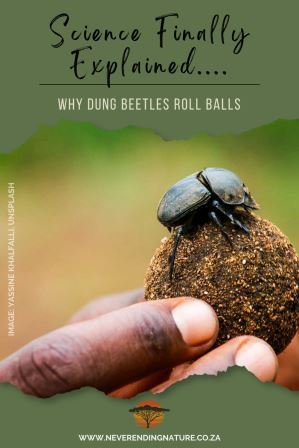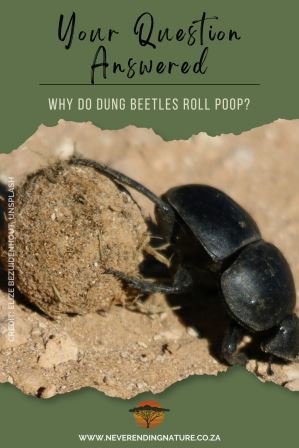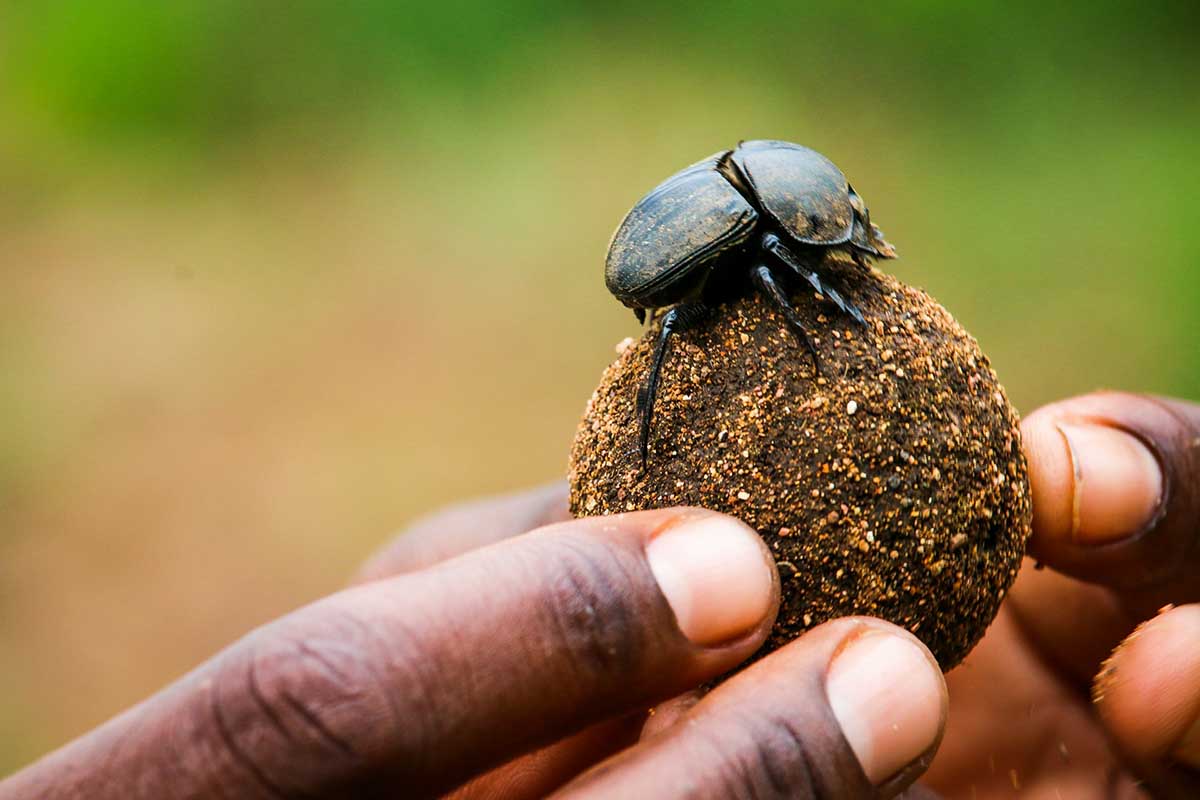
During my last three walks in nature, I encountered dung beetles going about their business. One was cleaning up after a dog on a hiking trail (one of my pet peeves – the dog messing on the trail), while the other two I found were rolling animal dung they found in the veld. Each time, I stopped and watched longer than I probably should have.
If you’ve ever done the same, you’ve likely asked: Why does this beetle work so hard for a ball of animal poo?
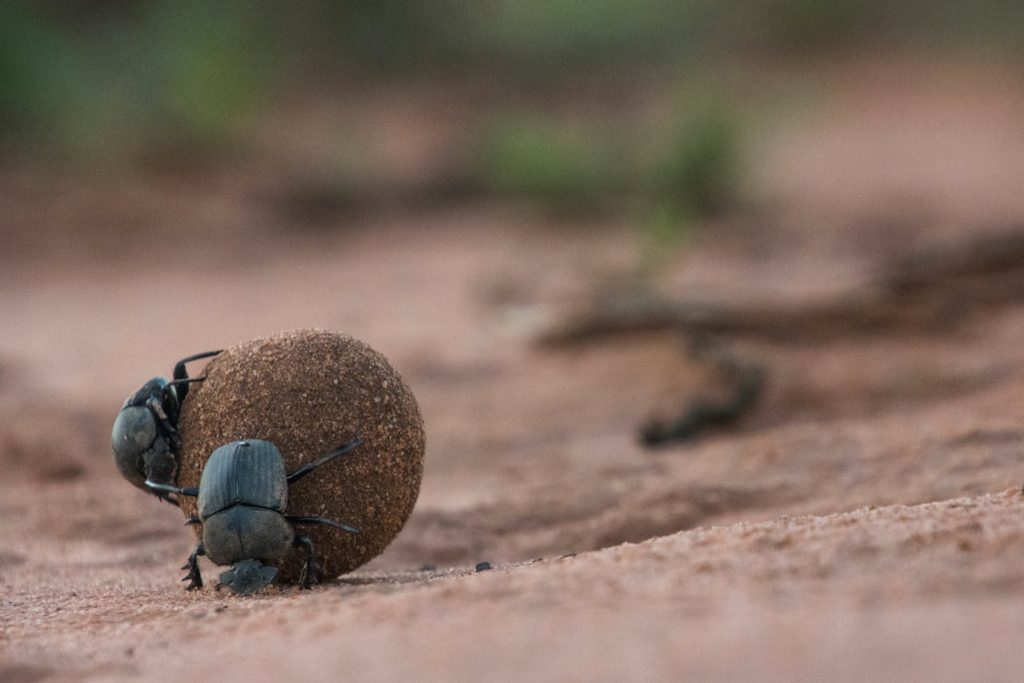
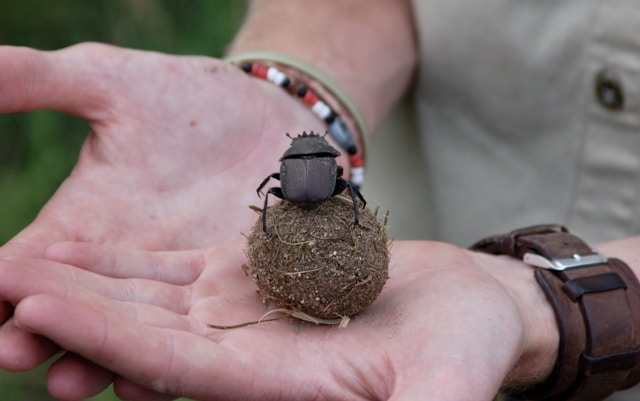
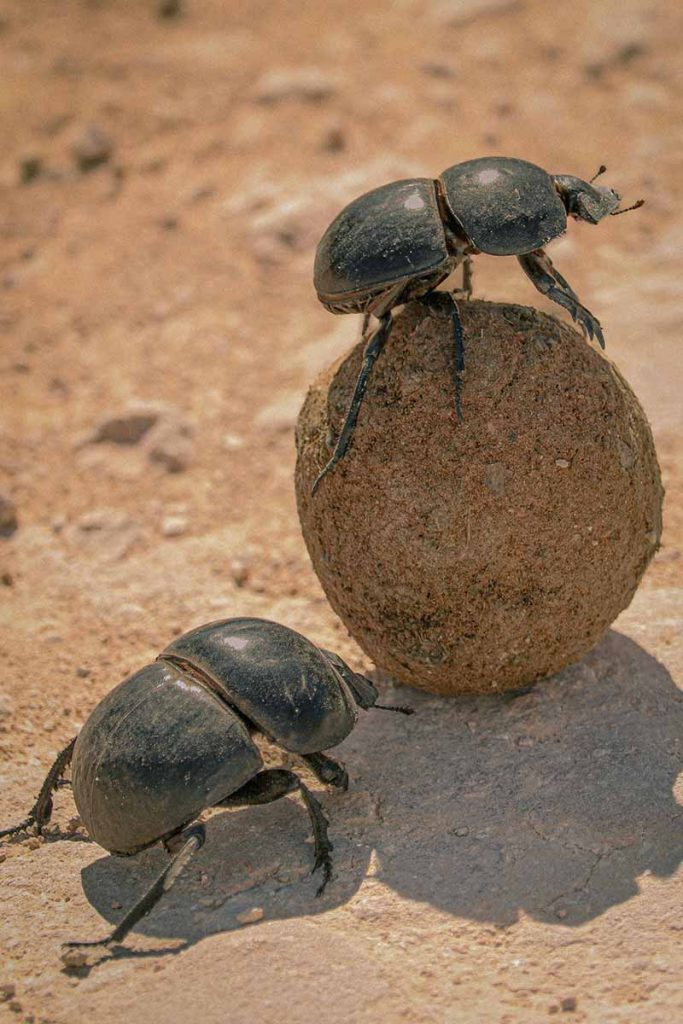
With their heads facing downwards, back legs pushing, they wrestle their prize over rocks, around twigs, through tufts of grass, and away from anything that might try to steal it. It might look a bit ridiculous, but it is one of their survival tricks. That ball of dung isn’t just nature’s cleanup crew in action.
So why do dung beetles roll dung balls? The short answer: they’re trying to get away with something valuable before another beetle takes it. The longer answer is far more interesting.
How dung beetles find fresh dung so fast
The moment an animal leaves a fresh pile behind, it releases a cloud of chemical signals into the air. To us, it’s just a bad smell. To a dung beetle, their antennae can pick up these odours at tiny concentrations, and they usually arrive surprisingly quickly after fresh dung lands on the ground. It can also get quite competitive.
Fresh dung is a brief window of opportunity, and beetles know it. They swarm, scramble, and steal from each other before it dries out, gets trampled, or runs out. Instead of fighting over a communal heap, roller beetles carve off a piece, pack it into a ball, and leave with the dung.
Not all dung beetles roll dung balls
The ball-rollers get all the attention, but they’re just one part of a bigger workforce. Dung beetles, of which there are more than 6 000 species in the world, generally work in three ways:
- Rollers form a ball and carry it away
- Tunnelers bury dung directly under the dropping
- Dwellers live and breed inside the dung itself
Each group is solving the same basic problem: how do you secure a short-lived, competitive food source before it’s gone?
Why dung is such a valuable food source
To us, dung is a waste product, but ecologically, it is concentrated leftover nutrition. Herbivore dung contains partially digested plant matter, microbial biomass, moisture, nitrogen compounds, and fine organic particles that smaller organisms can use with far less effort than processing raw leaves or grass from scratch.
Dung beetles do not chew through the same tough fibres as a zebra or buffalo. Instead, they feed on the finer digestible fragments and the dense microbial soup within the dung, which provides accessible nutrients.
Some species are surprisingly picky about it, too. Certain beetles prefer wetter dung, others favour particular animals, and some like it at a specific stage of decomposition. It’s a whole feeding economy, with specialists and preferences, built entirely around excrement.
What do dung beetles do with dung balls after rolling them away?
For many species, the dung ball becomes a place to raise the next generation. Once the beetle has rolled the ball far enough from the scrum of competitors, it buries it underground. In breeding situations, it lays an egg inside that ball. When the larva hatches, it’s surrounded by food. Moisture is sealed in. Temperature stays stable. Predators have a hard time reaching it.
Some dung beetle species even have males and females working together to prepare or guard these underground chambers, which is fairly unusual behaviour for insects. The ball does double duty: feeding the adults while giving the next generation the best possible start.
How dung beetles navigate in a straight line
Once a beetle has its ball, it can’t afford to wander. Every second near the dung pile is a second something could ambush and steal from it.
It needs to move in a straight line, fast. Before setting off, beetles often do something strange. They climb onto the ball, rotate slowly, and pause, almost as if they’re taking stock of their surroundings. During the day, they use the sun and polarised light patterns as a compass.
At night, they navigate by the moon. But in one of the most remarkable discoveries in insect biology, researchers in South Africa found that the nocturnal dung beetle Scarabaeus satyrus can also orient itself using the Milky Way. In planetarium experiments, beetles rolled in reliably straight lines when the Milky Way was visible. When the view was blocked, they lost their heading.
It was the first animal ever shown experimentally to use the Milky Way itself as a navigation guide. Think about that: a brain smaller than a grain of rice, quietly reading the galaxy before pushing a ball of dung into the dark.
Why dung beetles are important in ecosystems
Dung beetles are fun to watch, but their ecological role is just as important. Every ball buried underground means nutrients go back into the soil instead of baking away on the surface.
In the process, they:
- Return nitrogen and organic matter to the soil
- Improve aeration and water absorption
- Reduce parasite loads in the ground
- Cut down on breeding habitat for pest flies
In grazing areas, this benefits both wildlife and livestock. The value is real enough that Australia introduced several foreign dung beetle species because most native Australian dung beetles had largely evolved alongside marsupials and were poorly adapted to processing the large, moist dung produced by introduced cattle and sheep.
Without dung beetles, grassland ecosystems would be slower, fouler, and less fertile than most people imagine.
So why do dung beetles roll dung balls?
Rolling this treasure away means escaping rivals, securing food, and building a nursery for the next generation before opportunity vanishes. What looks strange from a distance is actually a relentless race against theft, heat, desiccation, and time.
Seen properly, the dung beetle is an engineer, recycler, parent, navigator, and opportunist wrapped into one armoured body no bigger than your thumb. The next time you see one walking backwards across the veld, remember that you are witnessing one of evolution’s neatest little machines at work.
Love stories like this one?
See more of our content under our latest posts. You can also join others like you by subscribing to our newsletter.
Did you enjoy this article about dung beetles? Remember to share this story on social media.