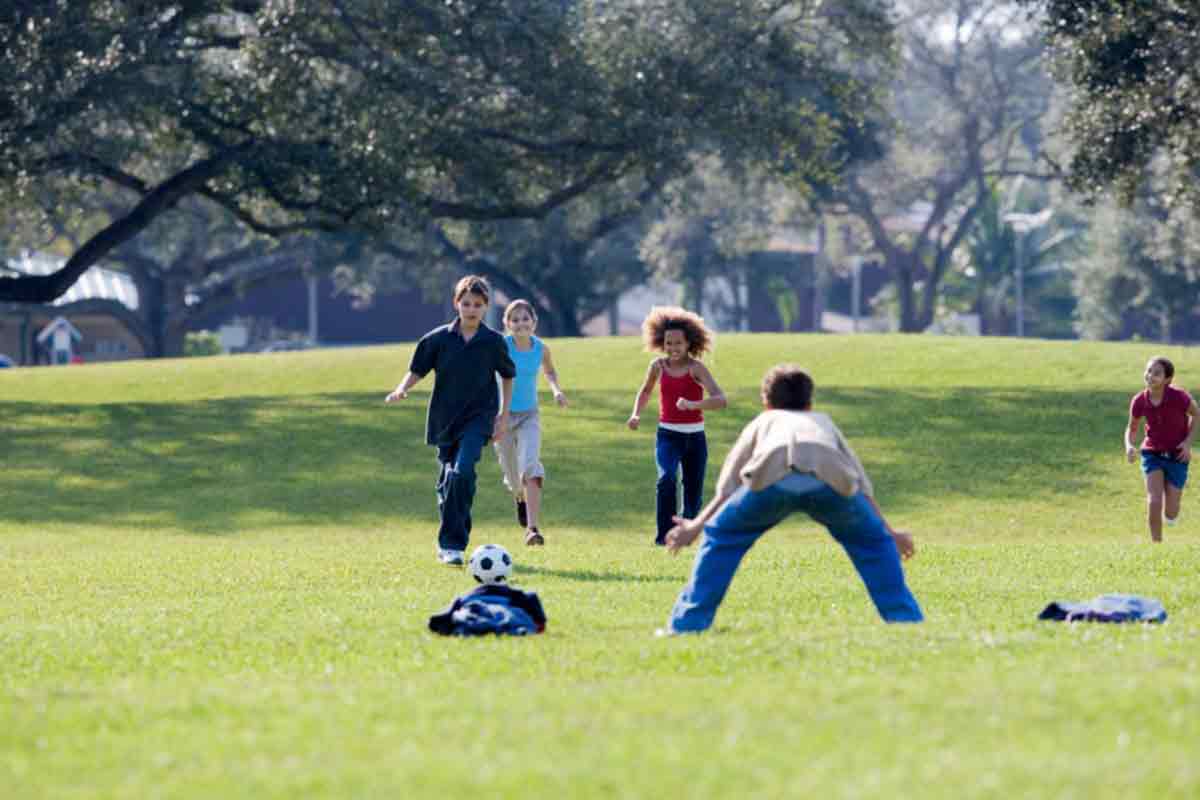
Spending time outdoors is often encouraged to keep children active and entertained. But could growing up surrounded by trees, parks and other green spaces also help them concentrate? New research suggests there may be a connection.
There’s a reason so many of us head outdoors when we need a break. A walk in the park, an afternoon in the garden or even a few minutes sitting under a tree can help us feel less overwhelmed by the noise and busyness of everyday life.
Children may benefit from that time outdoors too. In fact, a study published in Environment International found that children living in greener neighbourhoods tend to perform better in tests measuring attention and certain cognitive abilities.
Researchers from Washington University in St. Louis analysed data from 11,868 American children taking part in the long-running Adolescent Brain Cognitive Development (ABCD) study. The children’s average age was just under 10 years.
Rather than looking at how often the children visited parks or spent time outdoors, the researchers examined the green space surrounding their homes, including tree canopy and park cover.
They found that children living closer to green spaces generally performed better in tests of directed attention. This is our ability to focus on a task, ignore distractions and stay on track.
The researchers also found an association with higher scores in crystallised intelligence, which includes acquired knowledge and skills such as vocabulary and reading.
Why might green spaces help children concentrate?
The researchers wanted to explore a theory known as Attention Restoration Theory (ART). It suggests that natural environments can help restore our ability to concentrate after periods of mental effort.
Consider how often we have to shift our attention throughout the day. Emails, phone notifications, conversations and endless things demanding our attention can leave us mentally exhausted. Children face similar demands at school and at home.
Researchers believe nature gives our attention a chance to recover.
A natural environment can hold our interest without demanding too much from us. We might watch a butterfly moving between flowers, listen to birds calling from the trees or follow the movement of leaves in the wind. These little things catch our attention, but we don’t have to work particularly hard to follow them.
The team also investigated whether physical activity and air pollution could help explain the relationship between green space and cognitive performance.
Interestingly, physical activity didn’t account for the association. Air quality, however, appeared to play a part. The researchers found a connection between green space and exposure to fine particulate air pollution (PM2.5). These tiny airborne particles can penetrate deep into the lungs, making air quality an important factor in children’s health.
The researchers also considered other influences on attention, including household income, ADHD diagnosis, social media use and whether children felt safe in their neighbourhoods.
Does living near a park make children smarter?
Not necessarily. The findings are interesting, but they don’t mean that spending more time outdoors will automatically improve a child’s concentration or school marks.
The study identified a relationship between greener neighbourhoods and better performance in certain cognitive tests. It did not prove that one causes the other. Other factors could also influence the results, and researchers still need to establish exactly how green spaces affect children’s cognitive development.
Nevertheless, the findings add to a growing body of research exploring the relationship between natural environments and our ability to concentrate. We also published an earlier article with reasons to spend more time in nature.
Making room for nature
We don’t need to wait for more research to give children opportunities to explore nature. A garden can become an afternoon of searching for insects, a local park can offer space to explore, and a visit to a nature reserve can introduce children to plants, birds and wildlife they might never encounter at home.
These experiences encourage curiosity and give children opportunities to discover the world beyond their screens and schoolbooks. And who knows? That little patch of greenery down the road might be doing more for their developing brains than we realise.
Love stories like this one?
See more of our content under our latest posts. You can also join others like you by subscribing to our newsletter.
Have you seen the link between your children spending time in green spaces and concentration? Share your experience in the comments.
Copyright 2026 Never-ending Nature. All rights reserved. You may not republish or rewrite this article without permission.